
Digital inclusion
How can we promote digital inclusion?
As digital technology has become essential in our daily lives, more and more companies and local authorities are taking an interest in the challenges of digital inclusion.
Visual impairments, dyslexia, imprecise movements, colour blindness… Around 1 in 3 internet users struggle to use the internet independently, because interfaces are not adapted to their needs.
What is digital inclusion? Who is affected? What solutions exist to make the web easier for everyone to use? An explainer.

What is digital inclusion?
According to the AFNOR Spec “digital inclusion” guide (in French), published in February 2022 by AFNOR, the French standardisation body, digital inclusion “aims to ensure that every person, whatever their situation, has the means (connection, equipment, technology, finances, training…) to make full use of digital technology in the various areas of their life and thus to participate fully in society. It also aims to ensure that digital services, whether public or private, are designed, developed and maintained with all life situations in mind, and first and foremost with the people furthest removed from digital tools.”
Who is affected by digital inclusion?
A few figures for France:
- 6 to 8% of the population is affected by “dys” disorders, such as dyslexia or dyspraxia (source: OECD)
- 650,000 people have an autism spectrum disorder (source: INSERM, the French National Institute of Health and Medical Research)
- Deafness affects 6% of 15 to 24-year-olds and more than 65% of people aged 65 and over (source: INSERM)
- Parkinson’s disease affects around 200,000 people in France (source: French Ministry of Solidarity and Health)
- 61,000 people are blind (source: Valentin Haüy)
- 12 million people have a disability (source: ORCIP)
When internet users arrive on a website, they have to navigate an interface whose design is the same for everyone who visits that site. Yet most websites are not suited to certain disorders. In the pursuit of equity, every individual, whatever their specific needs, should be able to navigate independently on a website adapted to their own needs.
For example, a person with dyslexia (or another dys disorder) may find it very difficult to read the text on a website if the font is poorly chosen or the line spacing is too tight.
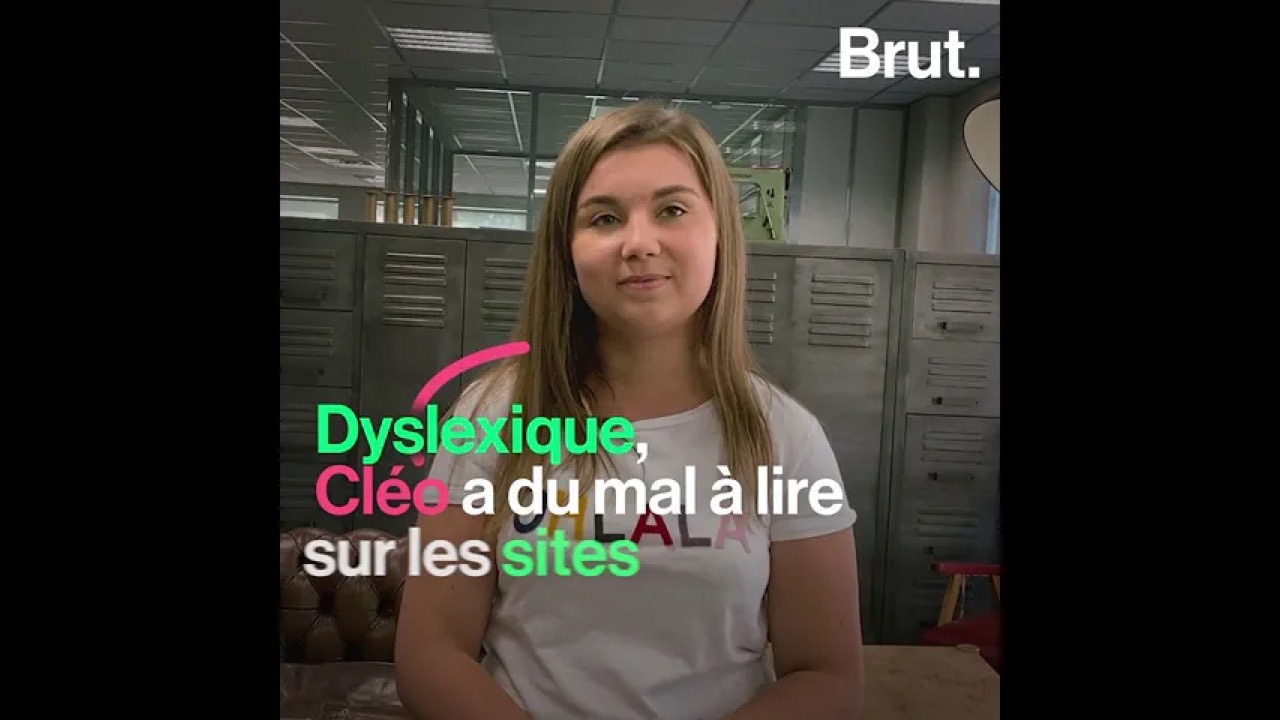
[Brut video] Testimonial from a young woman with dyslexia
Show transcript
- From 0 to 13 seconds
- The problem for someone with dyslexia is that we don’t necessarily see… well, it also depends on the dyslexia, but we don’t necessarily see the letters in the same place.
- From 13 to 18 seconds
- On the internet, the difficulties I have are with the page, finding my way around it.
- From 18 to 23 seconds
- So I have to use the mouse cursor to keep track of where I am.
- From 30 to 42 seconds
- If I go to a web page, you can see that the font has changed, the line spacing has increased and the text size has increased.
- From 51 seconds to 1 minute 1 second
- France is becoming more and more digital, so it is very important for all websites to take this accessibility approach into account.
Another example: colour blindness, a vision disorder that affects colour perception and concerns around 8% of men and 0.5% of women. A website with blue, green or red images or text can cause reading problems for people with colour blindness.
Beyond permanent disorders or disabilities, anyone may face a temporary disability at some point in their life. A few examples:
- a broken wrist, making it difficult or even impossible to use a mouse;
- impaired vision following surgery;
- eye problems (presbyopia, blurred vision…);
- migraines with visual aura (commonly known as ophthalmic migraines).
Anyone may face these situations, which can hinder or even prevent the use of a website or intranet.
Finally, according to INSEE, the French national statistics institute, nearly 17% of the population has no internet access or does not know how to use digital tools: this is known as digital illiteracy, another form of digital exclusion.
What is at stake in digital inclusion?
In a society where internet access has become essential in our daily lives, the stakes of digital inclusion are huge. They include:
- Access to employment: while most job offers are published online, 20% of jobseekers over 60 do not use the web in their job search because they are unfamiliar with it (source: Pôle emploi, the French public employment service). Likewise, an intranet or business tool adapted to employees’ specific needs fosters greater inclusion and equal opportunities.
- Greater independence: today, many administrative procedures must be completed online. Digital inclusion allows every citizen to be more independent in their daily life.
- A better quality of life: greater digital independence means less dependence on others and fewer trips to carry out everyday tasks (managing bank accounts, administrative procedures, shopping, etc.). This particularly concerns older people, who are enthusiastic web users (8 in 10 older people believe the internet improves their daily lives – source: Institut Amelis).
Having a website or intranet adapted to everyone’s needs is a concrete commitment that brings greater equity and independence.
What solutions exist to promote digital inclusion?
To promote digital inclusion on their websites and intranets, public and private organisations can, for example:
- Adapt the workstations of deaf and hard-of-hearing people with suitable solutions (for example, Tadeo, in French).
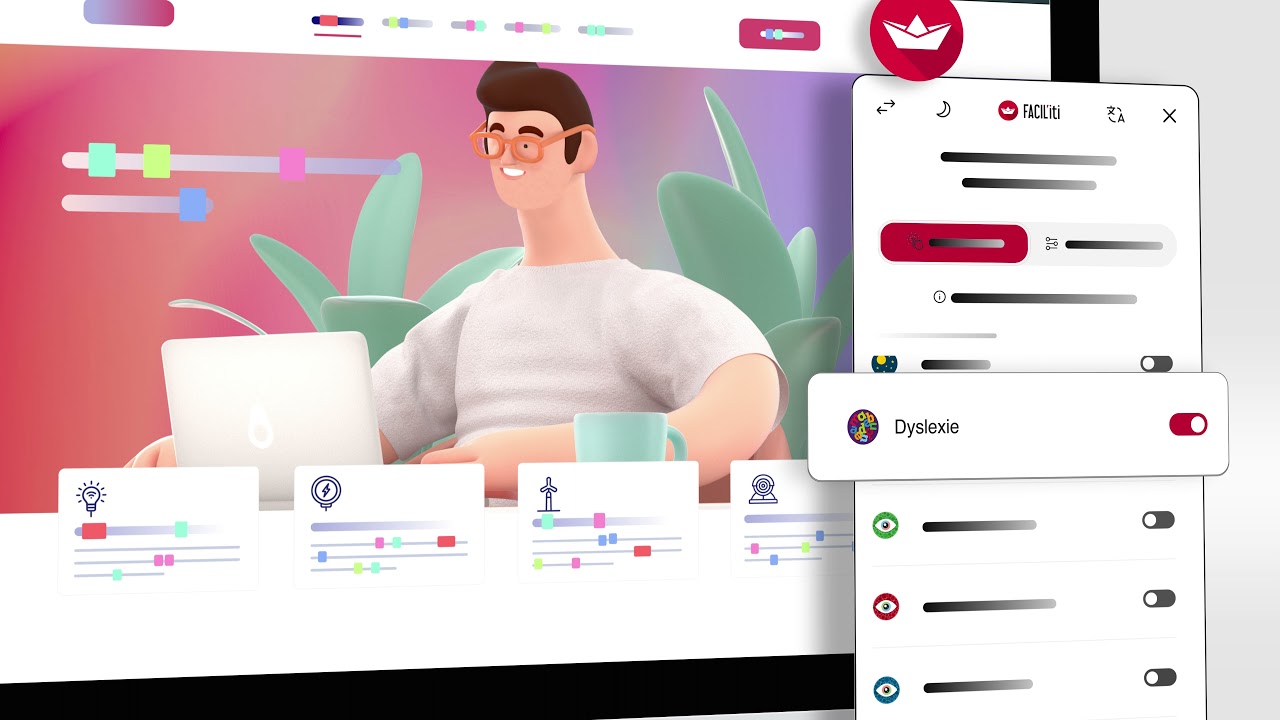
- Equip their websites and intranets with FACIL’iti, a digital inclusion solution that personalises how websites are displayed according to internet users’ needs. With 23 ready-to-use filters (dyslexia, colour blindness, presbyopia, Parkinson’s disease, cataracts, osteoarthritis, low vision…) and more than 1,000 custom filters, FACIL’iti offers a unique user experience on existing websites.
[Video] FACIL’iti, a personalised user experience at the heart of your website
Show transcript
- From 0 to 7 seconds
- A third of your internet users may not have access to your online content.
- From 7 to 16 seconds
- FACIL’iti adapts the display of your digital tools to your internet users’ preferences.
- From 17 to 21 seconds
- A tailor-made innovation, with no redesign required.
- From 22 to 35 seconds
- Select a filter: your intranet or website adapts instantly. More than 1,000 possible combinations with the “custom filter” feature.
- From 36 to 42 seconds
- FACIL’iti, your turnkey solution to broaden your web audience and affirm your values.
- From 43 to 48 seconds
- Digital inclusion: a positive impact for your organisation.
- Use Easy Read (FALC in French) to make information simpler and clearer.
- Develop websites using standards such as Opquast or the RGAA, the French accessibility standard. The latter makes it possible to optimise the speech output of screen readers, tools that blind people need for web accessibility.
- Train people who are far removed from digital technology, as well as website designers (developers, graphic designers, web designers…).
Committing to a digital inclusion approach is a concrete step towards equity and the fight against discrimination. It allows a public or private organisation to reach a wider audience, open up to new target groups and affirm its CSR values in terms of inclusion and diversity.