
Testimonials
Stéphane Houdet: “What is impossible, I will do”
At FACIL’iti, supporting inclusion is not a passing trend but a commitment we have held since our beginnings. Because our visions align, we interviewed Stéphane Houdet, international wheelchair tennis champion, who opened up to us with sincerity and humanity. A beautiful message about life.
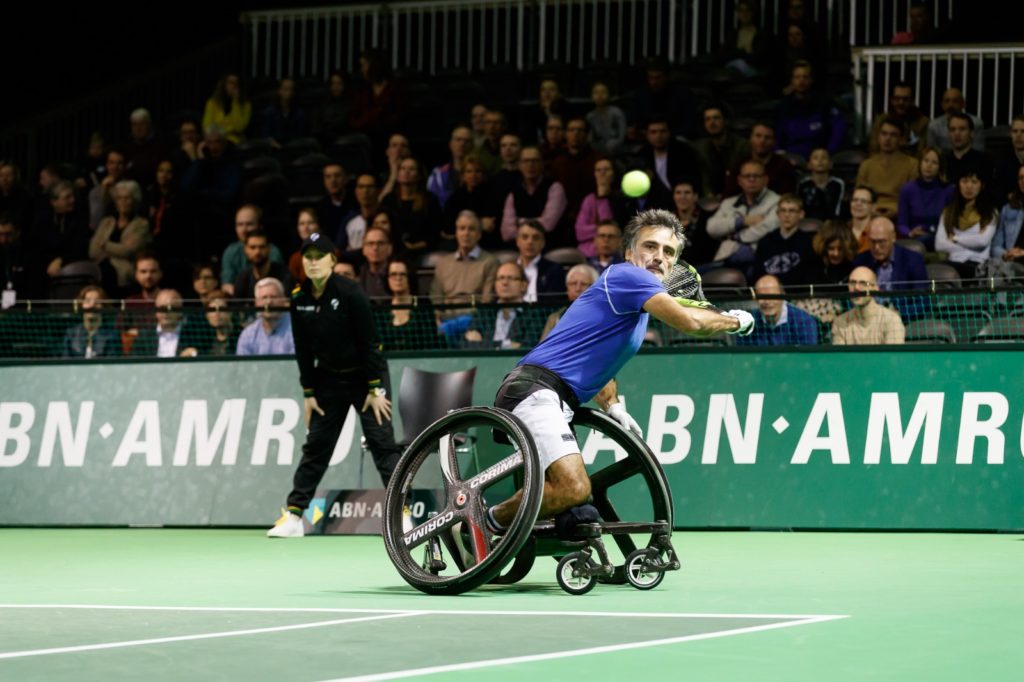
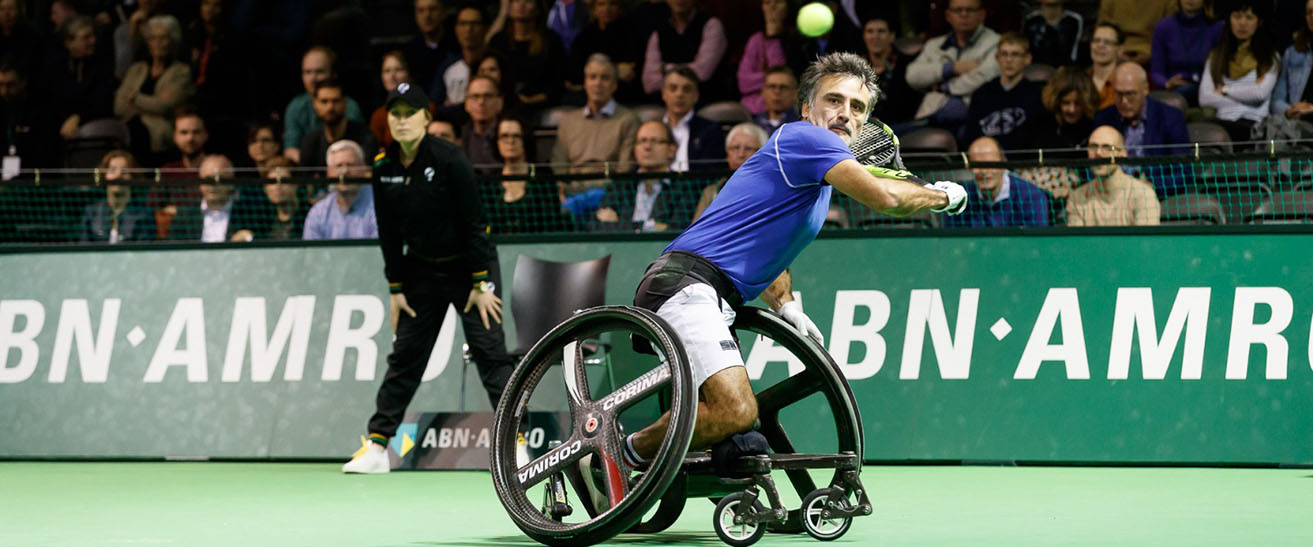
His record is impressive: four Paralympic medals, two of them gold, winner of twenty-three Grand Slam tournaments, currently world number 3 in singles and number one in doubles (he first reached the top spot in singles in 2012)… Stéphane Houdet’s career is extraordinary. Beyond these sporting achievements, Stéphane is above all a man of very strong values, with a rare kindness.
Hello Stéphane. On 9 August 1996, your life was turned upside down by a serious motorcycle accident that cost you the use of one leg. What gave you the strength to overcome this ordeal?
S. H.: “That day, I was overtaking a car that didn’t see me and that swerved to the left at that very moment to overtake some cyclists. I found myself stuck in the left-hand lane and hit the oncoming car with my knee. Ever since, I have always thought that a few centimetres either way and I would have passed between the two cars, but also that a few centimetres the other way and I would have hit the car head-on and died. So my leg is only a lesser evil. At twenty-five, I realised that life hangs by a thread, that it is fragile and that it is worth living.”
Do you think sport helped reveal your extraordinary capacity for resilience?
S. H.: “I used sport as a way of communicating with myself. After an accident like that, your self-image is badly damaged. Little by little, you set yourself new goals to get back on your feet: for me, after a fortnight in an induced coma, it was simply managing to put a spoon in my mouth without missing. I had played a lot of sport when I was younger. In my hospital bed, people often told me: ‘It doesn’t matter if you can’t do it any more, you’ve already done so much!’ Except that I was only twenty-five and, although it comforted me at the time, I don’t think I wanted to talk about my sport in the past tense.
“To complete my recovery, I needed to rediscover that image of myself as a child, as a sportsman, and more precisely as a competitive sportsman. When I was younger, I played tennis at national level, though not professionally, while studying to become a vet. After my accident, I felt the need to play sport again. I first became a para-golfer, and it was only eight years later that I discovered wheelchair tennis, which I knew nothing about and thought was reserved for paraplegics. I then went back to my first love: tennis. It is my guiding thread.”
There is still a long way to go to make it easier for people with disabilities to be included in everyday life. In your view, what actions should take priority?
S. H.: “For me, the first is accessibility in the broadest sense of the word: as soon as we manage to come together in the same place, I think we have won. It is the story of humanity: we go out to meet differences and we unite around differences. That is the journey of the human race: the ancient Olympic Games were reserved for rich, white Greek men. Today, everyone takes part: women and men, we all run together. I think the path towards inclusion is the same, which is why my battle would be to have a universal sport that can be played by everyone, together. For wheelchair tennis to be the first sport to apply for the Olympic Games, and not the Paralympic Games, where people are classified.”
We talk about the accessibility of places, but what about digital technology?
S. H.: “For me, accessibility is a general term: the web has become essential in our daily lives, so the internet must be accessible to everyone. That is what appealed to me about FACIL’iti, an innovative solution that allows a large majority of people to be included on the web, bringing people together. It is completely in line with my ideas about accessibility.”
You are the father of four children. What values and fundamentals do you pass on to them every day?
S. H.: “First of all: believing in yourself. That also means believing in human beings. Travelling around the world, you realise that people only want one thing: to share, to live together, despite wars and struggles. I have travelled a great deal and everywhere in the world, people want to open their doors to you.
“I also care deeply about respect and honesty: being transparent and not lying brings peace of mind. If you are aligned with yourself, you are at peace.
“Humility is also fundamental: we are only a grain of sand on the scale of the universe, almost nothing, a mere speck of dust. When you think about these scales, you have no choice but to be humble.”
Any goals and plans for 2020?
S. H.: “Yes: my first project is that I am getting married again! (Editor’s note: the team warmly congratulates him.) Alongside the wedding, I also have sporting goals for 2020, which are, as every year, the four Grand Slam tournaments and of course the Paralympic Games in Japan.”
A final message for our readers?
S. H.: “If it is possible, it is already done. If it is impossible, I will do it. When I started playing golf after my accident, I was told it was impossible to play with the type of prosthesis I wore. With the help of a friend, we developed a small part that allowed the prosthesis to rotate: so it became possible. If you really want to carry out a project and you set about doing it, anything becomes possible.”
The FACIL’iti team would like to thank Stéphane warmly for sharing his story.
Stéphane Houdet’s website (in French)
FACIL’iti is an official partner of Stéphane Houdet.