

Digital inclusion
Digital accessibility: a major asset for your website
In an increasingly connected world, digital accessibility has become a crucial issue for companies and organisations. Far from being a mere legal obligation, it represents a tremendous growth opportunity.
It is estimated that around 30% of the population cannot access online content(1), and nearly 97% of websites have a digital accessibility flaw on their very home page(2).
What are the benefits of an accessible website? How can you make the most of making a website accessible? An explainer.
What is digital accessibility?
Digital accessibility aims to make digital content and services usable by everyone, on all types of digital media (for example: websites, intranets, extranets, apps, digital kiosks…). An accessible website allows internet users (among other things) to:
- navigate with screen readers or braille displays (used in particular by blind and visually impaired people)
- personalise the display according to their own needs (enlarged text, changes to colours and contrast, choice of fonts…)
- navigate without a mouse (using the keyboard only, a touchscreen, their voice or any other suitable device)
A real need for millions of people
In France, 12 million people have a disability, to whom must be added many disorders and/or specific needs that can disrupt navigation on a website (or even make it impossible). A few examples:
- colour blindness, which affects 8% of men(3)
- autism spectrum disorders, which are thought to concern around 1% of the French population(4)
- attention disorders (ADHD), which concern around 2 to 3% of adults in France(5)
These figures underline the importance of digital accessibility in our connected society, where everyone must be able to buy from an e-commerce website, complete an administrative procedure or simply find information online.

A beautiful website is good. A beautiful and accessible website is better.
Here is an example of a website home page with accessibility problems:
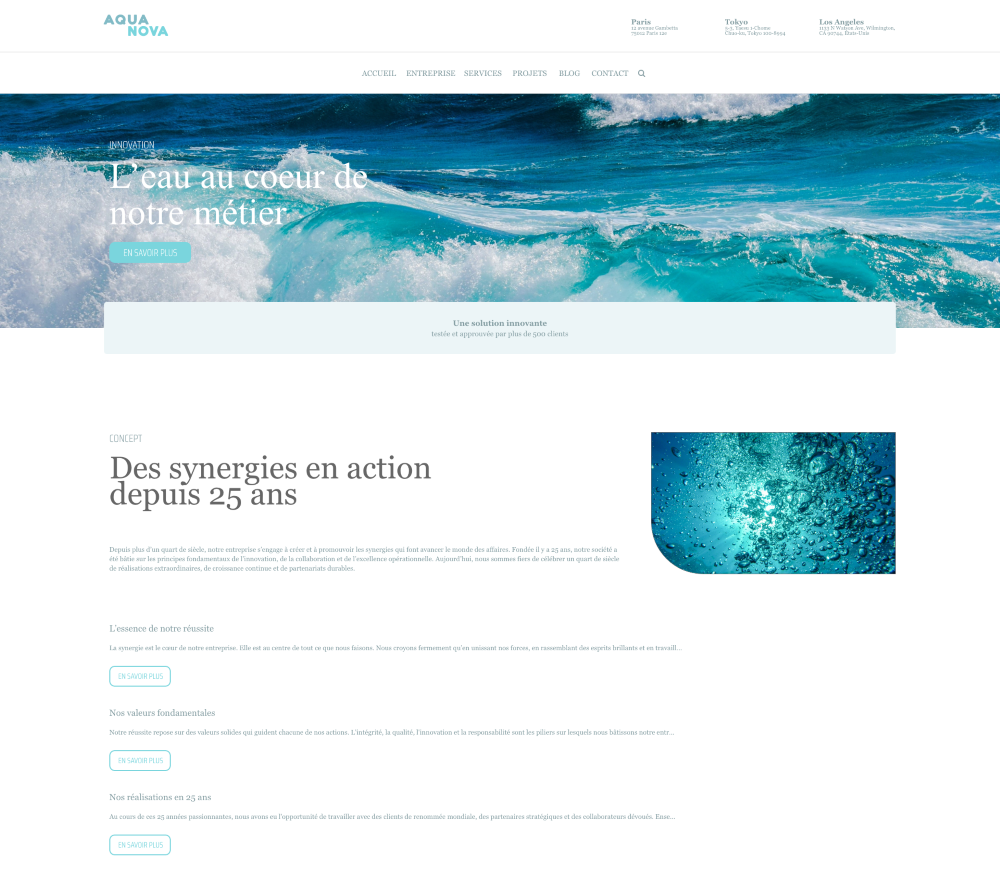
Accessibility problems include:
- ❌ the choice of fonts and their size = poor legibility for visually impaired people (and for everyone!)
- ❌ the menus at the top of the page = too close together, they prevent navigation for people with motor disorders (Parkinson’s disease, etc.)
- ❌ no contrast = not accessible to people with cataracts or low vision
- ❌ the “find out more” buttons = the labels are not explicit and therefore not accessible to visually impaired people
Now here is the same home page with improved website accessibility:
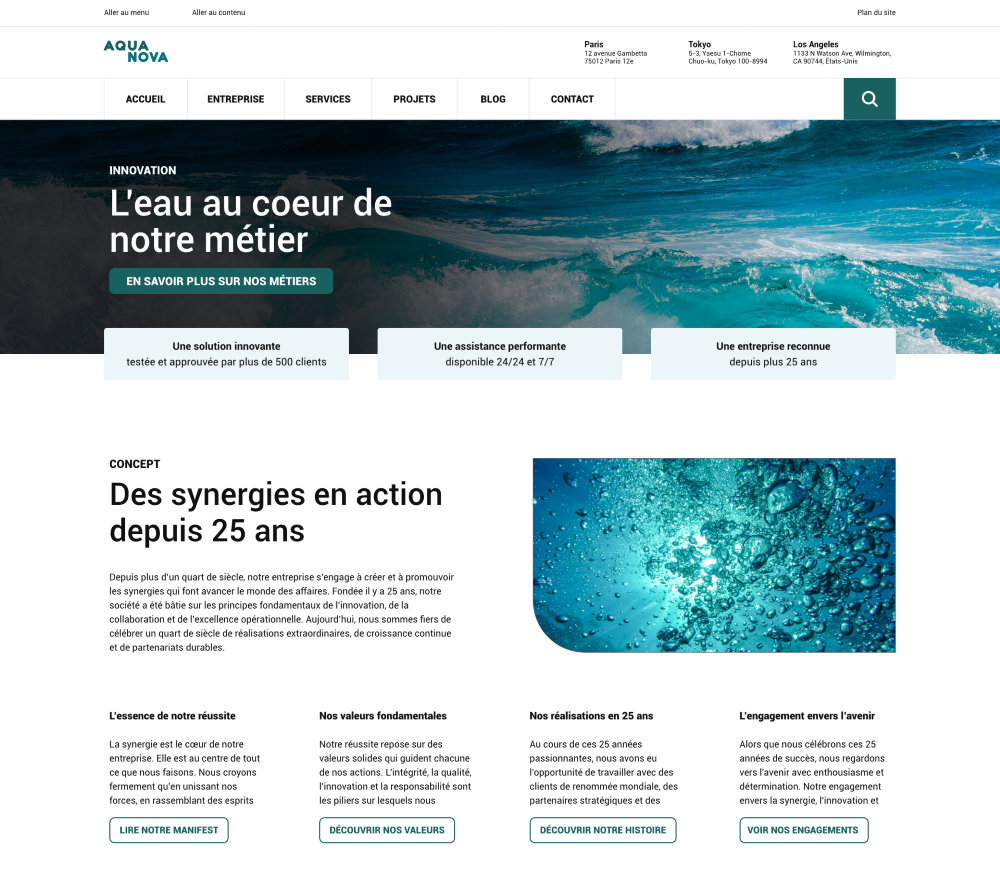
Note here that:
- 🟢 the contrast has been improved
- 🟢 the line spacing is larger
- 🟢 the font is more legible
- 🟢 the buttons are described (“discover our values”…)
- 🟢 a skip link has been added at the top of the page to make navigation easier (“go to menu, go to content”)
This is just a short example of good digital accessibility practices. To improve a website’s accessibility, the RGAA, the French accessibility standard, provides an operational framework for checking compliance with accessibility requirements.
An improved user experience for everyone
An accessible website does not only benefit people with disabilities: in fact, it improves the browsing experience for all users. A clear design, a logical structure and well-organised content make understanding and navigation easier for your whole audience. What is more, an accessible website often performs better in terms of loading speed and compatibility with different devices, which helps build visitor loyalty.
…and a legal obligation
In France, the implementing decree of 24 July 2019 (in French) sets out the digital accessibility obligations and the deadlines for compliance. The organisations subject to the digital accessibility obligation are:
- central government services
- local authorities
- public institutions
- organisations entrusted with a public service mission
- companies with a turnover in France of more than €250 million
- organisations of general interest
❗Watch out: from June 2025, the European Accessibility Act (EAA) will come into force, with new provisions imposing accessibility requirements on a larger number of companies and digital services. This will notably concern e-commerce websites, online banking services and e-books. Companies will have to ensure that their products and services are designed to be accessible, or face financial penalties of up to €50,000.
Accessible website: many benefits
Beyond regulatory aspects, having an accessible website offers many advantages:
👍 SEO optimisation of your website: web accessibility practices, such as the appropriate use of semantic HTML tags and the provision of alternative text for images, help improve your website’s search engine optimisation (SEO). This can lead to better rankings in search engine results and greater online visibility.
👍 Showcasing your CSR (corporate social responsibility) commitments: web accessibility is an important aspect of corporate social responsibility. By making your website accessible, you demonstrate your commitment to inclusion and equal opportunities, which can strengthen your brand image and attract customers and employees who share these values.
👍 Improved user experience: as we saw earlier, digital accessibility benefits all users, whether or not they have a disability. An accessible website is generally easier to navigate, more intuitive and offers a better overall experience for all visitors.
👍 A differentiating move: even though all websites should be made accessible, this is far from the case today. In a competitive context, a website that everyone can use is an asset to stand out.
How can I check whether my website complies with the RGAA?
To check whether your website meets the RGAA criteria, you need to carry out an accessibility audit. This audit must be carried out by digital accessibility experts to ensure its reliability.
Conclusion: digital accessibility, an opportunity for everyone
Digital accessibility is not a constraint but an opportunity for innovation and continuous improvement. By adopting good accessibility practices today, you offer a better experience to all your users and avoid digital exclusion. It is an investment that pays off in the short term, both ethically (inclusiveness, CSR) and commercially (reaching a wider audience).
Sources:
- (1) Contentsquare study
- (2) Website of the Conseil national consultatif des personnes handicapées (French National Advisory Council for People with Disabilities)
- (3) Syndicat national des ophtalmologistes de France (French national union of ophthalmologists)
- (4) Santé publique France (French public health agency)
- (5) Haute Autorité de santé (French National Authority for Health)