Testimonials
Aurélie, multi-DYS: “Being DYS is not a curse but an opportunity to innovate”
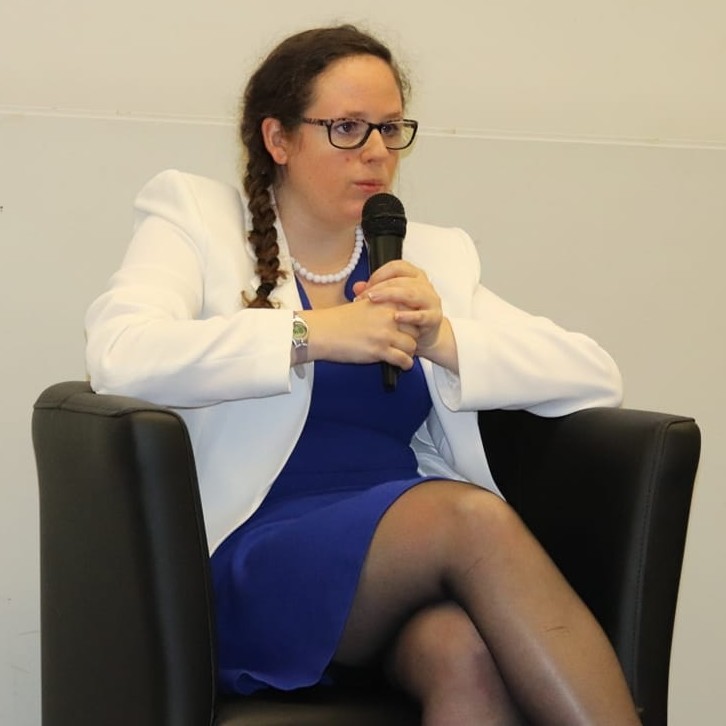
Last month, we had the pleasure of welcoming Aurélie Renard-Vignelles, founder of 6foisdys (in French), to our offices in Limoges. This dynamic, positive and very endearing young woman opened up to us with great candour in this testimony.
Hello Aurélie! Can you introduce yourself in a few words?
Hello, my name is Aurélie Renard-Vignelles, I will soon be 32 (on 28 April), and I am multi-DYS, with 7 DYS disorders, the French umbrella term for specific learning disorders (dyslexia, dysorthographia, dysgraphia, dyscalculia, dysphasia, dyspraxia and dysexecutive disorders), as well as ADHD. I am a speaker and trainer on DYS disorders, and also a DYS accessibility consultant. In August 2018, I founded my company 6foisdys, an entrepreneurial adventure that changed my life.
Why did you create 6foisdys?
I created 6foisdys to raise awareness of DYS disorders and train as many people as possible about them. Throughout my schooling, and also when looking for a job, I noticed that DYS disorders were poorly understood.
Unfortunately, I experienced bullying at school, discrimination and loneliness. But thanks to the support of my family, my friends and a few kind people, I managed to turn my disability into a strength.
People talk a lot about the difficulties faced by DYS people, but if compensation strategies and accommodations are put in place (at school, at work or in everyday life), you then discover the full potential of these extraordinary people.
Through my company, I therefore want to get the message across that you can be DYS and succeed in life. Being DYS is not a curse but, on the contrary, an opportunity to innovate.
What difficulties do you face in your daily life?
The difficulties I face every day are many, given my 7 DYS disorders and my ADHD. Among them, the most significant are:
- difficulty getting organised;
- difficulty planning tasks;
- difficulty concentrating;
- difficulty reading;
- difficulty finding my way around;
- difficulty following a phone conversation (due to my dysphasia, which is an oral language disorder);
- difficulty managing my emotions (anger, fear…).
Despite everything, I manage to move forward in life thanks to many coping strategies and a lot of accommodations.
Do you have any tips or ideas that anyone can easily apply to make life easier for DYS people?
I would say that to make life easier for DYS people, you first need to understand them by putting yourself in their shoes, by learning about the subject and by discussing their needs with them. Each DYS person has different needs, depending on the severity and type of their particularities.
In general, it is recommended, for example for dyslexic people (and for most people), to use a sans-serif font, a minimum size of 12 pt (ideally 14 pt), left-aligned (not justified), and to make sure the text is airy, with 1.5 line spacing. Dyslexic people can also have the content read aloud by the computer, where possible.
For possible accommodations for other DYS disorders, I invite you to refer to my brochure “DYS? Mode d’emploi!” (“DYS? A user guide!”) (in French).
What made you want to meet the FACIL’iti team?
In my introduction, I mentioned my work as a DYS accessibility consultant. As part of this work, I test apps to give my opinion on them, and also to suggest ways to improve them. I was lucky enough to be contacted to test the MYdys app as a person with severe dyslexia. When I saw the project, I immediately wanted to get involved and meet the FACIL’iti team.
I would also like to warmly thank the team for welcoming me to their offices in the Limousin region. A warm welcome and, above all, a real desire to put users at the heart of the project.
What do you think of MYdys, the reading assistance app developed for people with dyslexia?
For me, MYdys is a revolutionary app, whether for reading a not very accessible official letter, a magazine or a book, or for fully enjoying, as independently as possible, the information panels in exhibitions, museums or châteaux.
Before discovering MYdys, I had to use 2 apps to read information panels, or ask someone to summarise what was written. Now, if the internet connection allows it, I read information panels live by taking a photo of them, and MYdys transcribes them in a readable font, with the added option of having them read aloud and even sharing them with someone else. It is much simpler to have everything in the same app.
What are your plans?
My biggest short-term project is to publish my book, with an autobiographical part and a “tips and tricks” part for living with DYS disorders and/or ADHD.
In the long term, I would like to keep developing accessibility for DYS people, particularly in culture and tourism. I aim to self-publish my book, which will be a test for an upcoming project. One of my greatest dreams would be to do a tour de France of DYS people (with the aim of raising awareness of DYS disorders among ever more people).
As an African proverb says: “If you want to go fast, go alone; if you want to go far, go together!” The more of us there are to spread the message, the further it will reach.
Many thanks, Aurélie, for this testimony. Find 6foisdys on LinkedIn.